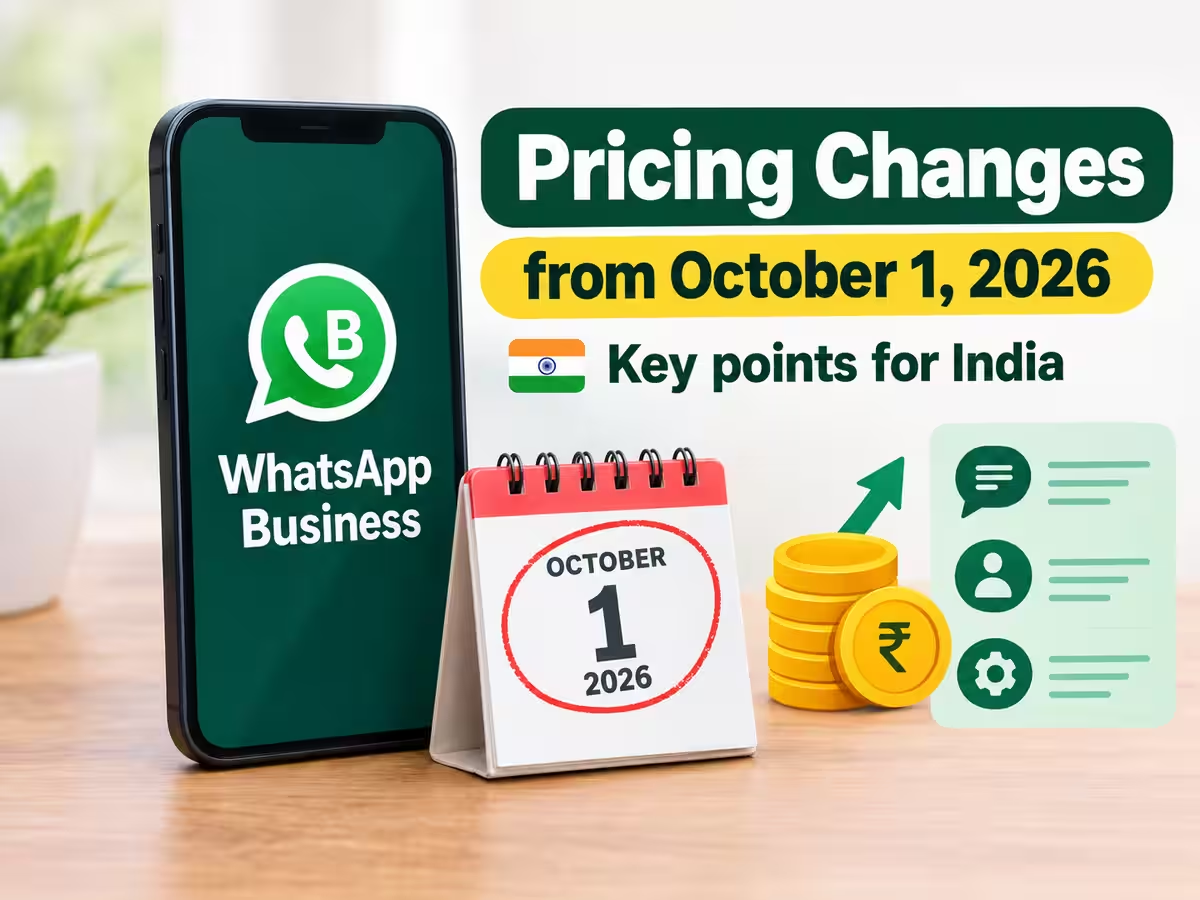
WhatsApp Service Messages Are No Longer Free: October 2026 Cost Changes Explained
- WhatsApp Business API & Pricing
- 14 Oct, 2026
- by Marketing Head
WhatsApp has become an essential communication channel for businesses that want to provide fast customer support, share order updates, answer enquiries and build stronger customer relationships. However, businesses using the WhatsApp Business Platform need to pay closer attention to their messaging costs following Meta's pricing changes effective October 1, 2026.
Previously, businesses could send ordinary service replies within the 24-hour customer service window without a separate service-message charge. Under the updated pricing model, service messages are now chargeable after an eligible monthly free allowance. Utility template messages sent during an open customer service window are also chargeable.
For businesses handling hundreds or thousands of customer conversations, these changes make messaging-cost management more important than ever.
In this guide, we explain what changed in October 2026, how WhatsApp service message charges work, what Indian businesses should know and how a WhatsApp CRM can help businesses manage customer communication more efficiently.
What Are WhatsApp Service Messages?
WhatsApp service messages are non-template messages that a business sends in response to a customer's message during the active customer service window.
For example, imagine a customer contacts an online store and asks:
- Where is my order?
- Can I change my delivery address?
- How can I reset my account password?
- Can you explain this invoice?
- When will my appointment be confirmed?
When a support agent replies directly to these enquiries using a non-template message within the permitted customer service window, that reply is generally classified as a service message.
These messages are important because they allow businesses to have natural, two-way conversations with customers instead of relying entirely on pre-approved templates.
However, the cost treatment of these replies changed on October 1, 2026.
What Changed in WhatsApp Business API Pricing on October 1, 2026?
Meta introduced changes to the WhatsApp Business Platform's pricing structure that affect service messages and utility template messages.
The key changes are:
- Service messages are now chargeable: Businesses receive a monthly free allowance of 1,000 service messages per business phone number. Applicable charges begin after the allowance is exhausted.
- Utility templates inside the 24-hour window are chargeable: Businesses should no longer assume these messages are free simply because a customer has recently contacted them.
- Marketing templates remain chargeable: Marketing messages continue to follow the applicable marketing message rates.
- Authentication messages remain chargeable: Authentication messages, such as eligible verification codes, follow the applicable authentication pricing rules.
- The 72-hour free entry-point window remains available under its applicable conditions: Conversations initiated through eligible Click-to-WhatsApp ads or Facebook Page call-to-action buttons can qualify for free message delivery during this window.
These rules apply to the WhatsApp Business Platform, including businesses using the API directly or through an official solution provider. They do not mean that ordinary personal WhatsApp conversations or the standard WhatsApp Business app have suddenly become paid services.
Businesses should consult Meta's current pricing documentation to confirm the rules that apply to their account and destination market.
How Does the 1,000 Free Service Message Allowance Work?
One of the most important changes for businesses in India is the monthly allowance of 1,000 service messages per business phone number.
Consider a company that receives customer enquiries through its WhatsApp Business Platform account. Its support agents reply to customers with ordinary, non-template messages.
The first 1,000 eligible service messages each month fall within the free allowance. Once that allowance is used, subsequent service messages become chargeable at the applicable rate.
The allowance is associated with each business phone number, not simply with the number of agents using a CRM. Businesses managing multiple numbers should review the applicable allowance and usage for each number separately.
It is also important to understand that the free allowance does not make every type of WhatsApp message free. Marketing templates, authentication messages and chargeable utility templates have their own pricing rules.
WhatsApp Service Message Pricing in India: October 2026
For Indian recipients, the reported rate for a service message after the free allowance is ₹0.115 per message.
The reported marketing template rate is ₹0.8631 per delivered message.
Message typePricing treatmentService messagesFirst 1,000 eligible messages per business phone number each month are free; subsequent messages are chargeableUtility template messagesChargeable under the applicable rate, including inside an open customer service windowMarketing template messagesChargeable at the applicable marketing rateAuthentication messagesChargeable at the applicable authentication rateEligible messages in a 72-hour free entry-point windowMessage delivery can remain free under the applicable conditions
These figures refer to the reported India rates effective October 2026. Rates vary by recipient country, message category and applicable pricing rules. Taxes, CRM subscriptions and solution-provider fees may be additional.
Always check the current Meta rate card and your provider's pricing before making financial decisions.
Example: How Much Could Your WhatsApp Service Messages Cost?
Let's consider an Indian business that sends 5,000 eligible service messages in one month through a single business phone number.
Using the reported October 2026 India rate of ₹0.115 per chargeable service message:
- Total service messages: 5,000
- Monthly free allowance: 1,000
- Chargeable service messages: 4,000
- Cost for chargeable messages: 4,000 × ₹0.115
- Estimated Meta service-message charge: ₹460
This example covers service-message charges only. It excludes other message categories, taxes, subscription costs and provider fees.
Your actual bill may differ depending on the applicable rate card, message classification, eligible free windows and account-specific conditions.
How Can Businesses Control WhatsApp Messaging Costs?
The goal should not be to stop communicating with customers. Instead, businesses should make their communication more relevant, organized and measurable.
Here are seven practical ways to manage messaging costs.
1. Review Your Monthly Message Usage
Start by checking how many service messages, utility templates, marketing templates and authentication messages your business sends each month.
Identify which categories contribute most to your bill and which customer journeys generate unnecessary messages.
A clear usage report makes it easier to estimate future costs and identify opportunities for improvement.
2. Avoid Unnecessary Follow-Up Messages
Repeated messages that provide no additional value can increase communication costs and frustrate customers.
Instead of sending multiple reminders for the same event, design a sensible follow-up schedule based on the customer's needs and the purpose of the communication.
For example, an appointment reminder should provide useful information and arrive at an appropriate time.
3. Make Every Message Useful
Keep messages clear, relevant and easy to understand.
For customer support, include the information needed to resolve the enquiry. For order updates, communicate the current status and the next expected step.
Useful messages improve the customer experience while reducing avoidable back-and-forth conversations.
4. Use Templates for the Right Purposes
WhatsApp message templates are important for business-initiated communications outside the customer service window.
Choose the appropriate category for each template and ensure the content follows Meta's current policies.
Do not assume that sending a utility template instead of a free-form service reply will automatically reduce costs. Utility templates are also chargeable under the October 2026 rules.
5. Track Marketing Campaign Performance
Monitor delivered messages, customer responses, conversions and campaign costs.
A campaign that generates many messages but few meaningful enquiries may need better targeting or a more relevant offer.
Use consent-based contact lists and respect customer opt-outs. Better targeting can improve campaign efficiency without relying on excessive message volume.
6. Organize Customer Conversations in a WhatsApp CRM
When multiple agents manage customer conversations independently, it becomes harder to maintain consistent communication and track unresolved enquiries.
A WhatsApp CRM can help businesses organize conversations, coordinate team responses and manage follow-ups from a shared workspace.
Depending on the platform's available features, businesses can also use campaign reporting and automation workflows to monitor activity and improve operational efficiency.
7. Calculate Your Total Cost of Ownership
Meta messaging charges are only one part of the total cost of using a WhatsApp CRM.
Your overall budget may include:
- Meta's message charges
- CRM subscription or platform fees
- Additional agent or workspace charges, where applicable
- Integration and implementation costs
- Applicable taxes
Compare the complete cost rather than choosing a provider based only on its advertised subscription price.
Why WhatsApp CRM Software Matters More After the Pricing Changes
The October 2026 pricing changes give businesses another reason to review how they manage customer conversations.
A well-organized WhatsApp CRM can help teams:
- Manage customer conversations from a central inbox.
- Coordinate support between multiple agents.
- Organize customer contacts and conversation history.
- Manage campaign workflows and monitor performance.
- Reduce avoidable manual work through appropriate automation.
- Review communication activity and improve follow-up processes.
A CRM does not automatically reduce Meta's per-message rates. Its value comes from helping businesses manage conversations, teams and workflows more efficiently.
For growing companies, that operational visibility can be just as important as the messaging price itself.
How WAServe Can Help Businesses Manage WhatsApp Communication
WAServe helps businesses manage WhatsApp customer communication through CRM and marketing automation capabilities.
Instead of handling every customer interaction separately, businesses can use an organized workspace to manage conversations, coordinate team activity and operate their messaging workflows more efficiently.
WAServe is relevant for businesses that want to improve how they handle customer support and marketing communication while keeping their messaging operations organized.
Before choosing a platform, businesses should review the features, pricing, integration requirements and applicable Meta messaging charges to ensure the solution fits their needs.
Want to improve how your business manages WhatsApp conversations?
Explore WAServe to learn more about its WhatsApp CRM and marketing automation capabilities.
Visit: https://waserve.com
Frequently Asked Questions
1. Are WhatsApp service messages still free in October 2026?
Not entirely. Under the updated pricing model effective October 1, 2026, each business phone number receives a monthly allowance of 1,000 eligible service messages. Applicable charges begin after that allowance is exhausted.
2. How much does a WhatsApp service message cost in India?
The reported India rate is ₹0.115 per chargeable service message after the free allowance. Confirm the latest rate card before calculating your actual bill.
3. Does the 24-hour customer service window still exist?
Yes. The 24-hour customer service window continues to govern when businesses can send ordinary non-template replies. However, being inside that window no longer guarantees that every business message is free.
4. Are utility template messages free inside the 24-hour window?
Under the pricing changes effective October 1, 2026, utility template messages sent within an open customer service window are chargeable at the applicable rate.
5. Are marketing messages also affected?
Marketing templates remain chargeable under the applicable market-specific pricing rules. Their cost should be considered separately from service-message charges.
6. Do the new charges apply to the regular WhatsApp Business app?
These changes concern the WhatsApp Business Platform. They should not be interpreted as introducing the same API message charges to ordinary WhatsApp or the standard WhatsApp Business app.
7. Are messages from Click-to-WhatsApp ads still free?
Eligible messages sent during the applicable 72-hour free entry-point window can remain free for message delivery. Eligibility conditions and any separate service charges should be checked against Meta's current documentation.
8. Can a WhatsApp CRM eliminate Meta's messaging charges?
No. A CRM can help businesses manage communication, organize teams and improve workflow efficiency, but it does not automatically remove Meta's applicable message charges.
9. How can I estimate my monthly WhatsApp Business API cost?
Estimate your message volume by category and recipient country. Apply the relevant Meta rates and eligible free allowances, then add applicable CRM subscription fees, provider charges and taxes.
10. Where can businesses check official WhatsApp API pricing?
Businesses should refer to Meta's WhatsApp Business Platform pricing documentation and their WhatsApp solution provider's current rate information.
Final Thoughts
The October 2026 WhatsApp Business Platform pricing changes make it more important for businesses to understand how their customer communication is billed.
The 1,000-message monthly service allowance in India provides some relief, but companies handling large numbers of customer enquiries should monitor their usage, review message categories and plan their budgets carefully.
The best approach is to combine clear communication, sensible automation and reliable reporting. With the right processes and CRM tools, businesses can continue delivering helpful customer experiences while keeping messaging operations under control.
Explore WAServe: https://waserve.com
Pricing note: Message rates and eligibility rules may change. Verify the latest Meta documentation and applicable provider fees before making billing decisions.
Share this Blog
More Blogs
WhatsApp Business API for Jaipur Businesses & Global Growth
How WhatsApp Business API is Helping Jaipur Businesses Scale Sales & Automate SupportAs the business landscape in Ja...
- 06 Oct, 2026
What is Whatsapp Business api complete guide for 2026
The Ultimate Guide to WhatsApp Business API & Automation in 2026As business communication evolves in 2026, tradition...
- 06 Oct, 2026
How to Run Safe WhatsApp Broadcast Campaigns Without Getting Banned
WhatsApp broadcast messages have an unmatched open rate of nearly 98%, making them a goldmine for marketing, flash sales...
- 02 Oct, 2026

Top 5 WhatsApp CRM Tools for Growing Businesses in 2026
As WhatsApp continues to dominate global communication, traditional CRM platforms like Salesforce and HubSpot are no lon...
- 02 Oct, 2026